

TC has had a hiatus in posting due to an old computer giving way to a new HP machine.
Happy New Year one and all.
2007 is going to be a big year for elections.
We are likely to have a federal election, and provincial contests in several provinces, including Ontario and Newfoundland for certain as they both have fixed dates in October. As well, Manitoba, Saskatchewan, Quebec & P.E.I. may go to the polls, but the governments in all those provinces are in political difficulty to one degree or another so delays are possible.
One interesting potential is that there could be minority governments in both Ontario and Quebec after the votes have been counted. Quebec has long had monolithic politics dominated by the Quebec Liberals and various nationalist competitors, but it is becoming more fragmented both federally and provincially. The big development of the past few years is the emergence of the leftist Quebec Solidaire, not as a serious contender for power or even seats, but as a drain on PQ votes. Despite recent strengthening on the part of the Quebec Liberals, this election is still leaning to the PQ.
In Ontario, there have been many polls in the past two years showing a close race between Liberals and the PCs, with the NDP making gains. More recently the polls have been suggesting a second albeit reduced Liberal majority.
TC thinks it highly likely that the Saskatchewan NDP, in power since 1991, will finally lose office. See this time series of Saskatchewan party preference polls conducted by Environics. (You have to scroll way down to find it.)
In Manitoba the election looks to be both close and interesting. The NDP have never won a third term in Manitoba but Premier Gary Doer is an astute and highly experienced politician, and gives the NDP their best chance ever of yet another victory. The most recent Probe Research Poll does give the Conservatives a narrow three point lead, but the pollsters theselves argued after the release of the poll that because the Tory gains were concentrated in rural areas, the poll could actually mean an NDP win. TC shares that assessment; however, the real message of the poll is simply that it could go either way.
Subscribe To

 Posts
All Comments
Posts
All Comments
Friday, December 29, 2006


Sunday, December 10, 2006
The Honeymoon
It seems like a return to normalcy (as Warren Harding so inelegantly put it). The Grits are back. Two polls out this weekend, one from Ekos, the other from Ipsos, would both produce Liberal majorities.
There is a strong Stéphane Dion honeymoon underway. Given that one must automatically cede 40+ constituencies to the Bloc in Quebec, it is difficult in Canada for anyone to win a majority, which makes these results all the more impressive.
An average of Ipsos and Ekos gives us the following seat distribution:
Liberal - 163
C.P.C. - 89
NDP - 8
BQ - 47
Other - 1
However, this is just first blush. Dion is not well known outside Quebec so these preferences must be considered as weak.
There is a strong Stéphane Dion honeymoon underway. Given that one must automatically cede 40+ constituencies to the Bloc in Quebec, it is difficult in Canada for anyone to win a majority, which makes these results all the more impressive.
An average of Ipsos and Ekos gives us the following seat distribution:
Liberal - 163
C.P.C. - 89
NDP - 8
BQ - 47
Other - 1
However, this is just first blush. Dion is not well known outside Quebec so these preferences must be considered as weak.
Monday, December 04, 2006
Dion & the NDP
Dion could potentially cause harm to the part of the NDP’s appeal that comes from urban social liberals for whom issues such as the environment, gay marriage and more arts funding are major concerns, but Dion will have little impact on the party’s appeal to its poor, working class constituents. Dion’s appeal may be a challenge for the NDP in places like Ottawa Centre, Trinity-Spadina or Parkdale High Park, but of little or no consequence in Winnipeg North Centre, Vancouver East or Timmins- James Bay.
With green competition from the official Green Party and now from the Liberals plus an incumbent neo-con government that will tempt its supporters to vote strategically, the circumstances facing the NDP are highly adverse. However, they do have strong leadership on the part of Layton, who for example, was busy this summer touring small communities suffering from hard times in the softwood lumber industry. It would be a mistake to be dismissive of a party that is ably led, and currently in far stronger shape than in the mid-nineties.
With green competition from the official Green Party and now from the Liberals plus an incumbent neo-con government that will tempt its supporters to vote strategically, the circumstances facing the NDP are highly adverse. However, they do have strong leadership on the part of Layton, who for example, was busy this summer touring small communities suffering from hard times in the softwood lumber industry. It would be a mistake to be dismissive of a party that is ably led, and currently in far stronger shape than in the mid-nineties.
A little post game analysis
The results of the third ballot on Saturday took my breath away. I always thought Dion could win, but I was astonished at the sheer scale of the switch by Kennedy delegates to Dion. Clearly it was a large number of anti-Rae (& anti-Ignatieff for that matter) Ontario delegates who made the difference.
In some ways it was a process of elimination: the long race revealed Ignatieff’s fundamental flaws, Rae despite a skilled performance simply wasn’t acceptable to the Ontario wing of the party, and Kennedy could not speak French.
It is a little unwise in the immediate wake of such an event to make sweeping comments about the consequences of such an event, but the pundits have weighed in, and their negativity is summed up nicely in this post by Paul Wells.
It is foolish to make glib comments on what will happen in Quebec, as many do, in the next election. It is a notoriously difficult province to read. Ahead of time no one predicted Chrétien’s success in 2000, or Harper’s breakthrough in 2006. Dion does start at almost an historic low point for the Liberals in Quebec. Perhaps he has nowhere to go but up?
Dion may not win the next election (governments usually defeat themselves). The Globe poll this morning makes also clear he is simply not well known in English Canada. But he is smart and savvy, and his 10 years of political experience will serve him well. The test will come with the demands of being number one in the organization, the test Martin failed so miserably.
His most important advantage is that he is the first post-Inconvenient Truth major party leader in Canada, and TC thinks the zeitgeist will see astonishingly rapid growth in concern about global warming in the next few years. No one is now better situated to take advantage of that.
In some ways it was a process of elimination: the long race revealed Ignatieff’s fundamental flaws, Rae despite a skilled performance simply wasn’t acceptable to the Ontario wing of the party, and Kennedy could not speak French.
It is a little unwise in the immediate wake of such an event to make sweeping comments about the consequences of such an event, but the pundits have weighed in, and their negativity is summed up nicely in this post by Paul Wells.
It is foolish to make glib comments on what will happen in Quebec, as many do, in the next election. It is a notoriously difficult province to read. Ahead of time no one predicted Chrétien’s success in 2000, or Harper’s breakthrough in 2006. Dion does start at almost an historic low point for the Liberals in Quebec. Perhaps he has nowhere to go but up?
Dion may not win the next election (governments usually defeat themselves). The Globe poll this morning makes also clear he is simply not well known in English Canada. But he is smart and savvy, and his 10 years of political experience will serve him well. The test will come with the demands of being number one in the organization, the test Martin failed so miserably.
His most important advantage is that he is the first post-Inconvenient Truth major party leader in Canada, and TC thinks the zeitgeist will see astonishingly rapid growth in concern about global warming in the next few years. No one is now better situated to take advantage of that.
Saturday, December 02, 2006
Turn out the lights....
The party's over. Dion gained 65.7% of the increased votes on the third ballot, Rae 19.8% and Ignatieff 14.6%. Stéphane Dion will win the Liberal leadership on this next ballot.
Results of first two ballots
Here are the numbers from the first two ballots:
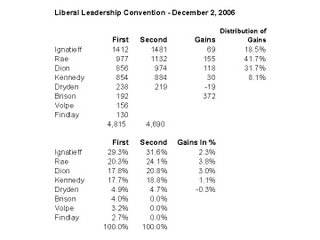
There were 1103 ballots cast for Kennedy and Dryden.
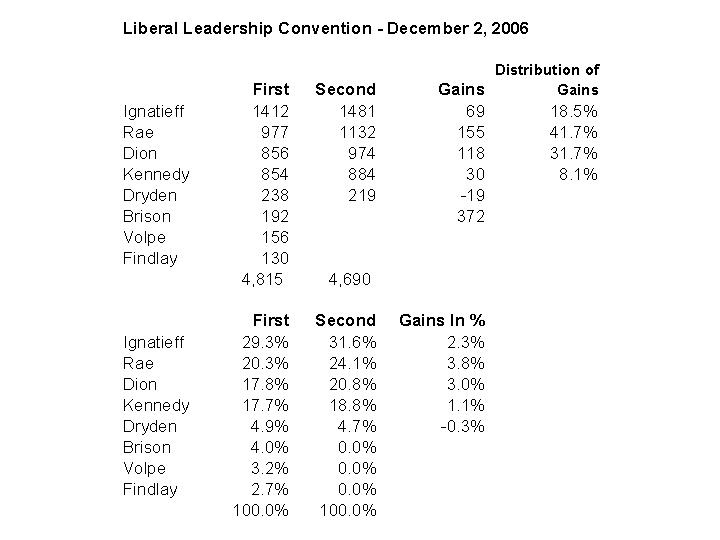
There were 1103 ballots cast for Kennedy and Dryden.
Second Ballot - Where do we go from here?
It seems quite clear now that Ignatieff won't win, but he did not suffer a major meltdown on this ballot, which presumably assures him a place on the final ballot.
So can Dion overhaul Rae who leads him by 158 votes? The Kennedy camp has a large number of Ontario delegates, many with a history of opposing Rae. The leading candidates (including Kennedy) gained 372 votes on the second ballot. This time there are about 1100 to be redistributed. Could Dion could make it to the final ballot? It is by no means certain. The winner will be either Dion or Rae.
So can Dion overhaul Rae who leads him by 158 votes? The Kennedy camp has a large number of Ontario delegates, many with a history of opposing Rae. The leading candidates (including Kennedy) gained 372 votes on the second ballot. This time there are about 1100 to be redistributed. Could Dion could make it to the final ballot? It is by no means certain. The winner will be either Dion or Rae.
Subscribe to:
Posts (Atom)