

I have moved my blogging to a new Substack here: tcnorris Substack.
Subscribe To

 Posts
All Comments
Thursday, April 25, 2024
Monday, February 07, 2022
Ontario election 2022 might set a precedent
Polls over the past year seeking the views of the Ontario electorate have found a split that seemingly favours a re-election of the Ford government with a majority. Going back to last June, a year prior to the upcoming election date of June 2, the PCs have averaged about 35% support, five percentage points less than they obtained in 2018 while the average for the Liberals and NDP is 27% each. However, much of the analysis of this dead even split takes no account of a history of tactical voting in Ontario, both federal and provincial, dating back to 1999. I fully expect either the Liberals or the NDP to demonstrate during the election campaign that they are the more popular alternative to Ford - at this point I am not sure which it will be. The consequence of that will be late movement towards the party with the best chance of defeating the PCs, not necessarily dislodging the Ford PCs from first place, but likely sufficient to prevent a PC majority.
Even if the PCs win the most seats, the NDP and Liberal leaders have recently strongly suggested that they will not let Ford continue to govern. Fifteen years ago this would have been unheard of. The Canadian electorate accepted the legitimacy of the party finishing first simply carrying on with the business of government.
At a recent panel discussion NDP leader Andrea Horwath said, "I don’t see any scenario where I would support a Doug Ford government... If (Liberal leader) Steven Del Duca is prepared to support the kind of things that we want to see happen to fix what’s wrong in Ontario then I would welcome that and I would be prepared to have that conversation". For his part del Duca predicted "I don’t believe that I’ll be able to support Doug Ford... Doug Ford has demonstrated consistently ... he’s not the right person for the job. He doesn’t have what it takes — not the capacity, the curiosity, the interest or the skill set to get us through to the recovery and rebuild this province".
There was a time not long ago where the electorate accepted the first place finisher in our first-past-the-post electoral system as the legitimate winner. No longer. The idea of the acceptability of voting coalitions in legislatures has been growing. We saw this at work in BC following the 2017 provincial election when the NDP and Greens came to an agreement. If that type of accord could oust the Ford government following the 2022 election, I fully expect to see it happen. The PCs could be tossed from office even if they are, say, 10 seats and a couple of percentage points ahead.
 |
| Doug Ford with snow shovel |
One of the conundrums of Ontario politics is that all three party leaders are seriously weak. Doug Ford is an incompetent clown whose first chief of staff, Dean French, had to be sacked due to a nepotism scandal, following a year where he engendered intense hostility throughout the halls of government, both bureaucratic and political. More recently, following a record snowfall Ford went out in his car to help other motorists who were stuck using a child's shovel (the link is to an amusing video), rather than working with provincial and municipal officials on managing the response to the storm. It was absurd.
However, both of the opposition leaders are weak. NDP leader Andrea Horwath has frequently demonstrated poor political judgement, while Liberal leader Stephen del Duca is an exceptionally inept political performer.
Nonetheless, one of these three must wind up as a winner. I increasingly like the odds of one of the opposition leaders becoming premier.


Wednesday, January 12, 2022
Election 2021 Observations
Overall the results of the 2021 election were unremarkable. The result was acutely disappointing for the Liberal government, but their expections for a majority may have been misplaced. What follows are some observations about 2021.
1963 & 1965
The 2019 and 2021 elections bear a striking resemblance to the 1963 and 1965 elections. Both 1963 and 1965 produced Liberal minorities that were disappointments for the Liberals as they had expected to win a majority in both cases. Clearly the 2021 election was called by Justin Trudeau because numerous polls prior to the call of the election suggested that a majority was within reach, quite similar to the calling of the 1965 election by Lester Pearson on the urging of Walter Gordon and Keith Davey.
 |
| Lester Pearson & Walter Gordon |
An important Liberal mistake was anticipating that gains in Quebec would carry them much of the way towards a majority. In part the Bloc got lucky gaining ground based on the aggressive behaviour of the host of the English TV debate, which overall she handled badly. However, it revealed how brittle Quebec nationalist sensibilities can be. The Bloc portrayed the host's question on Bill 21 as an attack on Quebec. The political dynamic in Quebec is at best elusive; a similar unexpectedly strong performance on the part of the Ralliement créditistes of Real Caouette in rural Quebec in 1965 contributed to the Liberal failure then. I remember a pollster on the 1965 CBC election night coverage excusing his results by saying they were off base mainly in rural Quebec.
Pork Barrel Politics
When there is an impending election the party in power tries to take advantage of it by funding local projects to pick up a marginal seat. I wrote about this last summer: "The Liberal government gives every signal that they intend to call an election in late summer or early autumn with the goal of converting their minority into a majority. One such sign was the announcement of federal money on July 9 for the extension of the Skytrain in BC in Surrey and Langley, which is aimed at shoring up existing Liberal ridings while targeting narrowly held Conservative Party of Canada (CPC) constituencies such as South Surrey-White Rock and Cloverdale-Langley City." So how did that turn out? The results were mixed: the Liberals did win Cloverdale-Langley City, a new seat for them, by three points, but lost the South Surrey-White Rock riding by a similar amount. The Liberals did keep their existing ridings in the region.
Chinese Ridings
The Liberals picked up three constituencies with large Chinese populations: Richmond Centre and Steveston-Richmond East in British Columbia, and Markham-Unionville in suburban Toronto. Given there was so little seat shifting the change is notable. Some argue that it was partly a product of a disinformation campaign by China, which was reacting to Conservative party policy proposals. However, it is conceivable the strong criticism of the Conservative party of Chinese human rights violations could have been interpreted by some members of the community as being anti-Chinese. Either way it did not affect the net outcome.
The Polls
On the whole, with a notable exception, the polls were accurate in 2021. I compared both the national and regional polls to the results. The most accurate polling firms were Leger, Ipsos and Research Co when you include all the regional numbers. The exception was the IVR (Interactive Voice Response) polls - ie being phoned by a computer. They significantly overestimated support for the PPC (People's Party of Canada).
The PPC and Greens
The PPC measurably increased its support in this election, from 3.3% in 2019 to 4.9% in 2021 (but won no seats) essentially campaigning as an anti-vaccine party (its strength was strongest in rural Manitoba). Following its disastrous leadership change, the Green Party dropped 4.1 percentage points between the two elections and ended up with one less seat.
Third Party Interventions
There are always interests and individuals seeking to affect elections. Former Liberal cabinet minister Jody Wilson Raybould, elected as an independent in 2019, wrote a critical memoir centred on the SNC Lavalin Affair and was, according to Jeffrey Simpson, "so determined ... to wound the prime minister and his party in the 2021 election that she apparently advanced the memoir’s publication date to maximize the hurt it might do to her former colleagues." As best I can tell it had no impact. Most intervenors in elections are similarly unsuccessful.
What should we expect in our political future
During the campaign, Earnscliffe Strategies sponsored weekly polls by Leger and provided discussion in the form of a webinar. One session focused particualarly on second choices. The election delivered a disappointing outcome for the NDP but the poll suggests the NDP may be well positioned going forward (see 8:20 onward). Nationally more voters indicated second choice support for the NDP than any other party
 |
| Earnscliffe Leger Poll 2021 Election |
Gregg was referring in this instance to the short term of the election campaign but it might be appropriate to think about it in a longer run context.
As the Official Opposition, the Conservatives are generally thought of as the most likely alternative government, but if Gregg's comment is right, they will have a hard time getting there.
The NDP also benefits from Jagmeet Singh's popularity, although it is strongly correlated with age. Singh is quite popular with younger voters. There are a number of different questions used to measure personal popularity. One of the best measures is 'Who do you prefer as prime minister?'. This appears to be closest to actual vote choice. The Nanos poll asks more than one including preferred prime minister. Trudeau is almost always first around 30%. This week O'Toole was second and Singh third, near 20%. Last week it was the reverse. Singh has the most support when the question is about 'has the qualities of a good political leader' (note: not prime minister).
Will Trudeau Retire from Politics?
I like gossip as much as the next person but the Ottawa press corps is obsessed with gossip about Trudeau's departure so you see a great deal of coverage. When asked, Trudeau said clearly he is not leaving. If you want to figure out what will happen history strongly suggests that he is far more likely to hang on too long than leave early. Party leaders that have hung on too long in recent history include Brian Mulroney (leaving Kim Campbell not much time to get ready for the next election), Pierre Trudeau (remember the 'peace initiative'), Jean Chrétien (helping provoke the clash with Martin), and John Diefenbaker (he had to be ousted by Dalton Camp). There are several more. Ignore the gossip.
Saturday, September 18, 2021
And the winner is....
This election campaign has left a sour taste in everyone's mouth. It was unnecessary and has let loose a wave of anti-social behaviour, particularly on the part of PPC adherents and anti-vaxxers. It appears the Liberals will win the most seats, likely somewhere in the 140-150 range with the Conservatives somewhere in the 120-130 range. Almost all seat projections would yield a Liberal plus NDP majority in the House of Commons. It is quite possible that vote shares for the two leading parties will wind up lower than their respective vote shares than in the 2019 election. For the Liberals a minority outcome would be a result comparable to the bitter fruit the party tasted at the time of the 1965 election.
It also appears the election has not been kind to the Conservatives; they have been forced on the defensive on issues including ranging from vaccinations to health care to abortion to gun control. Erin O'Toole has quite skilfully tried to come down on both sides of contentious issues without appearing opportunistic. To me he has simply appeared to be dishonest and untrustworthy - not just dishonest in the dissembling way one normally expects from political speech but beyond that.
One party that is clearly doing better this time is the NDP, benefiting in part from dissatisfaction with the two leading alternatives, particularly the Liberals. It is possible, if everything went the NDP's way, they would end up somewhere in the 40-50 seat range. More likely is something in the 30-40 seat range, still a large improvement on the 24 seats they captured in 2019. NDP support is disproportionately young, the demographic with the lowest turnout. In today's Nanos poll the NDP leads in the 18 to 34 age group with 34% of the vote to 22% for the Liberals and 20% for the Conservatives. Another factor is that some who prefer the NDP nonetheless vote Liberal to prevent the Conservatives from achieving success.
A key reason the Conservatives are having a tough time ousting the Liberals is that relatively few non-Conservatives cite them as a second choice.
A poll conducted by Leger for the Earnscliffe Strategy Group produced the following finding:
In January 2019, 22% of Liberal supporters named the CPC as their second choice, falling to 16% in October of that year. Now, just 2% would support the CPC, while over half (58%) give their second-choice support to the NDP.
If we go back over the decades it is the Liberal Party and Conservative Party (in its various iterations) that have provided alternative governments to Canadians. Is that era coming to an end? It is too soon to say, but this evolution in public opinion seems significant.
The other big problem for the Conservatives is that they are no longer the big tent party on the right. The gains of the PPC this time are almost certain to be modest, but most of their votes are coming from the Conservatives. Nick Kouvalis, a pollster and Conservative strategist - he worked for Rob Ford and is currently working for Doug - blames the PPC for the likely Liberal victory in the latest press release issued by his polling firm Campaign Research. It is reminiscent of the nineties and the split between the Reform Party and the former Progressive Conservative Party, albeit on a more limited scale. However, it would take just a few percentage points to deny Erin O'Toole's Conservative Party a good result.
Because there has been a great deal of voting this year by mail and special ballots, results which won't be known until Tuesday, we might not learn the final shape of the House of Commons until the next day. However, polling from Nanos suggests the gains post election day will not go to the Conservatives:
According to Nanos Research’s nightly tracking data conducted for CTV News and the Globe and Mail, which was released on Friday, those Canadians who plan to vote by mail-in ballot are four times more likely to vote for the Liberals than the Conservatives...
Of those who rated their likelihood to vote by mail as a nine or 10 on the scale:
47 per cent would vote Liberal;
26 per cent would vote NDP;
12 per cent would vote Conservative;
6 per cent would vote Bloc Quebecois;
6 per cent would vote Green Party; and
2 per cent would vote People’s Party of Canada
In 2019 the polls significantly underestimated the Conservatives; every major polling firm understated the Andrew Scheer Conservatives by an average of 2.6 percentage points nationally; in Alberta it was 11.1 percentage points. Will it happen again? Have the polling firms made adjustments to reflect 2019 experience? We don't know. One party that has a lot riding on this is the NDP. As things stand now, the party is poised to make significant seat gains in Saskatchewan and Alberta, but a repeat of the same polling phenomenon could negate those potential wins. The pandemic has not been kind to Jason Kenney or Scott Moe. That could be an offsetting factor as could the rise of the PPC.
The 2020 election in the United States produced significant polling error. A key explanation that emerged later was that there was increasing distrust on the part of the political right in institutions including polling. It could be repeated here.
Sunday, September 12, 2021
The last week: where things stand
State of the Race
In the last few days the Liberals have begun inching upward in various polls, in particular in the Nanos daily tracking poll for the Globe and Mail and CTV, the Mainstreet poll for iPolitics (you can see all the polls on Wikipedia). Both Nanos and Mainstreet had quite accurate polls in 2019, so they deserve to be taken seriously. The growth for the Liberals may be connected to the debates, but it seems to have started earlier. These results point to a Liberal minority that would be stronger than their pre-election position but short of a majority. There has also been some upward movement for Maxime Bernier's People's Party of Canada (PPC) - scroll down the CBC's poll tracker page to see the graphic showing poll shifts over time to see this. While a little of their support comes from elsewhere, most is coming from the Conservatives. One province showing weakness in Conservative support is Alberta, weak enough that the NDP and Liberals could pick up seats. However, polling there in 2019 underestimated the actual Conservative vote by eleven points. In the United States in 2020 there is evidence that small 'c' conservatives did not respond to polls to the same extent as liberals. We should not be surprised to see something along these lines in Canada, although polling firms are now aware of the problem.
The Debate
The debate was atrocious. I did not think they could get any worse but this one did. The Globe's John Doyle nailed it in his TV column:
What happened across multiple Canadian TV channels was the worst of the worst, an example of utter failure in Canadian television, and a disgraceful insult to the intelligence of viewers and voters.
That was not a debate, it was a farce. The fact that the political leaders even agreed to participate in the format is an indictment of their collective intelligence....
Moderator Shachi Kurl took the view that her job was to stop the leaders from talking. This was a peculiar tack to take. You see, at its best, television coverage isolates and highlights the strengths and flaws of individuals. It goes to the core. It can push aside propaganda and posturing. Politicians and the public know this. It’s why the U.S. debates proceed with deep seriousness. Here, in election debate after election debate, the event has tended to descend into bickering and masquerade.
I agree with all of this. One reform I would like to see (among many) is that there be only one live mike at a time for the politicians. The cross talk and interruptions make the debate extremely confusing for viewers. If only one mike is on at a time, the speaker who has the floor will be heard easily above one who tries to interrupt. As it was in this debate the moderator frequently took the side of the interrupter and told the speaker to stop. It was the worst performance by a debate moderator ever.
The significance of Suburban Toronto
The region where the Conservatives are hoping to make significant gains in Ontario is known as the 905 after its area code and consists of suburbs west, east and north of Toronto. Half of these constituencies are in the west, a third in the north and a smaller number in the east.
The Conservatives swept this area in 2011, the Liberals in 2019. The top two tables below report the results for 2019 and 2015. The third table gives the comparison. Note that while the Liberals maintained their strength overall in 2019 they slipped a bit in the north and east but actually gained in the west. The suburbs to the west of Toronto include primarily Mississauga, Brampton, and Oakville. The population there is becoming more diverse, that is, more like Toronto, where Conservative support is weak.

I would look for Conservative gains (if they re-establish their earlier campaign strength) first in York Region, the suburbs north of Toronto. The Conservatives are targeting seats here and were successful in luring a Liberal elected in this region in 2019 to cross the floor, no doubt in part because she sensed Conservative strength here.
The NDP and Jagmeet Singh
To date the NDP is running ahead of its pace in 2019, and looks set to pick up seats. Leader Jagmeet Singh is polling particularly well in surveys that ask specifically about leadership. A recent Abacus poll found he had the strongest net positives among the leaders. The problem is that leaders are not on the ballot but parties are. Nonetheless, Singh is proving to be an adept campaigner and communicator.
However, the NDP vote is strongly correlated by age (in the most recent Mainstreet and Nanos they were either tied or ahead in the youngest age cohort) so turnout is exceptionally important. The NDP is quite a bit weaker among older voters who tend to turn out more strongly while younger voters have lower turnout (see this Statistics Canada survey). It bodes well for the NDP in the longer run. Because the Conservatives did well early on in the campaign they could also lose votes to tactical voters who may prefer the NDP but will nonetheless vote Liberal if they fear the Conservatives.
Normally, one should not expect much movement in the final week of a campaign but this one is close; there are recent shifts that may not be finished. There is higher than normal uncertainty.
Wednesday, September 01, 2021
Election Campaign 2021 and the polls
Election 2021 features quite a few polls including daily tracking polls from Nanos and Mainstreet, who were among the most accurate polling firms in 2019. The table below presents calculations of the difference between actual election results and the late campaign provincial & regional subsections of national polls in 2019. I converted the errors into absolute values, added them up and ranked the pollsters. The top three performers in 2019 (seen below with a white background) were Leger, Mainstreet and Nanos.
In my view the polling firms in the middle with the light gray background also did well - Abacus, Research Co and Campaign Research. The others in darker gray below were less accurate.

These pollster performances could look different in 2021. The pollster with the best record over time is Nanos, the firm doing daily tracking polls for the Globe and Mail/ CTV News. So far the polls suggest that the Liberals' hoped for majority is a chimera. I hate the term "polls show"; polls are not so unswervingly accurate, so they deserve less declarative language.
The results so far should be regarded as tentative and preliminary. The arrival of the autumn will bring TV debates in the week following Labour Day. They are likely to be highly influential on the final result.
Although parties devote much space to detailed policy proposals the public looks at the big picture: it is symbolic politics that are decisive.
The Liberals popularity declined almost as soon as the writ was dropped. It is likely the Trudeau government was unpopular before writ. Six years of accumulated grievances will do that. However, the Liberals' polling and other public opinion research such as focus groups should have been looking for that and they ought to have found it. Clearly they weren't looking.
The Dishonesty of Erin O'Toole
The Conservatives are running an extremely dishonest, but highly effective campaign, a much more effective campaign than Andrew Scheer mounted in 2019.
An Andrew Coyne column in the Globe and Mail helps illustrate the nature of the Conservative campaign.
"...So Conservatives must be thrilled to find Erin O’Toole showing promise of the requisite shamelessness. The Conservative leader has not just survived the inevitable Liberal attacks in the campaign’s first week, he has seemed almost to invite them, luring the Grits into wasting valuable rhetorical ammunition on a series of dummy controversies.On vaccine mandates, on abortion, on health care, Mr. O’Toole has said things that at first sound difficult, controversial, or at least noteworthy, but which on closer examination turn out to mean nothing – nothing, that is, substantively different from Liberal policy, the status quo, or both. Liberal attempts to turn these into wedge issues have accordingly largely fizzled.Some of this facility had been in evidence even before the Conservative platform was released. The Conservative promise to balance the budget “over the next decade” is a masterpiece of meaninglessness: the latest projections from the Parliamentary Budget Office show the budget will be all but balanced – a deficit of less than 1 per cent of GDP – inside of four years. It would require heroic acts of profligacy to prevent it from balancing in 10."
Coyne is right about this meaningless promise, but it lets the Conservatives appear to be fiscally prudent, when it is probably their intent to run large deficits in budgets, which include big tax cuts for their friends, financed by additional borrowing. It is the symbolism that counts. Quite brilliant, but entirely dishonest.
More Coyne:
".... On abortion, Mr. O’Toole’s vociferously pro-choice position seemed to deprive the Liberals of a target – until the release of the Conservative platform, with its vow to “protect the conscience rights of health-care professionals” who object to providing services such as abortion or assisted suicide. Again the Liberals pounced, only to find their wedge blunted once again: doctors are not required to provide those services now.They are required to provide “effective referrals,” something Mr. O’Toole had promised to scrap during his leadership campaign. Would he still? Alas, no, as he later clarified: the promise now is merely to “protect” doctors’ existing conscience rights. The status quo, in other words."
Coyne should ask the rhetorical question if this is no change: why say anything? Because that rhetoric is a strong symbolic bow towards the anti-abortion crowd within Conservative ranks. He is saying "I am sympathetic to your feelings. I will try to do something for you." It may not amount to much - public opinion in Canada is strongly pro-choice. Stephen Harper did not try to introduce an abortion law. However, he firmly prohibited Canada's international aid money from being spent on family planning that included access to abortion. In other words he is saying he is with the anti-abortionists in spirit if not in practice. Again, brilliant but dishonest.
We go through the same thing again on health care. Coyne again:
"By the time the Liberals shifted their focus to health care, they were already looking punched out. Still, did they really think, in 2021, after so much talk of the perils of online misinformation, they could get away with posting a video of Mr. O’Toole saying he would allow provinces to contract with private, for-profit providers, while snipping out the bit about ensuring “universal access remains paramount”?Again: private provision of services within a system of universal public insurance is common practice now – under the current, i.e. Liberal government. All the Liberal war room achieved by this ham-fisted gambit was to make themselves the issue, rather than their intended target.Mr. O’Toole’s talent for double-talk may not make for much coherent policy. But as a survival tactic, its merits are undoubted. The point of a wedge issue is to force a party leader to choose between his base and the broader public. It takes some artful duplicity to wriggle out of this trap: to adopt a position of such bottomless vacuity, impenetrable yet suggestive, as to allow each group to take away from it what they prefer.
Again we have to ask why say this. Because O'Toole wants to appeal to the pro-privatization part of the Canadian electorate. This includes many affluent Canadians who want to buy their way to the front of the line, something that would seriously undermine Canada's health care system. However, his rhetorical frame lets him deny it. My impression is that it seems to have worked at the symbolic level, which is the point of the gambit. However, it is remarkably dishonest and suggests to me that O'Toole is further to the right than he is letting on. Coyne seems clueless about all this: symbolic politics have a reality underneath that should not be ignored.
So far I have neglected to mention the NDP. To date they are running a successful (for a third party) 'happy warrior' campaign, and Jagmeet Singh is achieving new heights of personal popularity. More on the NDP in a future post.
Wednesday, August 11, 2021
Is it time for a Liberal majority?
 |
| 1965 Liberal Campaign Button |
The record of minority governments seeking to become majorities is mixed. Probably the most spectacular success was that of John Diefenbaker in 1957 when he called the 1958 election and won one of Canada's largest majorities ever. A year later Manitoba PC Premier Duff Roblin engineered his defeat in the legislature, turning his minority government into a majority in the ensuing election. On the other hand, Stephen Harper was handed a setback when he called the 2008 election not long after legislating a fixed election date law that he promptly ignored. He saw an opportunity for a majority but it faded during the campaign; he wound up with a minority.
We have seen a pattern of success and failure among provincial governments as well. Bill Davis failed in Ontario in 1977 to attain a majority (seeking to reverse the minority outcome in 1975) , while Manitoba PC Premier Gary Filmon won a snap election in September 1990 following two yars in a minority. Quebec Liberal Premier Jean Charest won a majority the same way in 2008 following being reduced to a minority in 2007. Nova Scotia PC Premier Rodney Macdonald tried for a majority in 2006 but didn't get it, and lost outright to the NDP in 2009. The New Brunswick PC government of Blaine Higgs converted a minority into a majority this year, while John Horgan did the same thing for the NDP last year in BC. There have been others as well.
One conclusion I reach is that, despite current appearances, a Liberal majority is not a lock. I averaged a few recent polls and the seats projected; the estimate based on that average is a Liberal majority of 177 (101 C, 36 NDP, 24 Bloc and 1 Green) but the dynamics of an election campaign could easily change that. Indeed, 177 is a marginal majority and by no means certain. The number of previous attempts by others nonetheless suggest that the incentive to seek a majority is strong and elections called to win a majority in similar circumstances will continue in the future.
One final point: there is much discussion at the moment about whether there should be an election. Some argue that an unnecessary election (and I agree it is unnecessary) will hurt the Liberals. Some cite the example of David Peterson's early election call in 1990 leading to the victory of Bob Rae's NDP. I don't think it will be an issue, and it will be forgotten once the campaign is underway. There was a poll early on reporting the Ontario Liberals way ahead in 1990. But there was a great deal of public opiniton research that was not public at the time that suggested the Peterson government was quite unpopular (See the book Not Without Cause: David Peterson's Fall from Grace for details). I think an election will be called on Sunday, August 15 and whatever else may be said, the fact of calling the election will not be a significant election issue. But Justin Trudeau's majority project, which looks strong now, could fail.
Saturday, July 10, 2021
Election fever
The Liberal government gives every signal that they intend to call an election in late summer or early autumn with the goal of converting their minority into a majority. One such sign was the announcement of federal money on July 9 for the extension of the Skytrain in BC in Surrey and Langley, which is aimed at shoring up existing Liberal ridings while targeting narrowly held Conservative Party of Canada (CPC) constituencies such as South Surrey-White Rock and Cloverdale-Langley City.
As soon as a party finds itself in a minority, it immediately begins scheming how to restore its majority. The Liberals appear quite confident that they will be succussful, so we should take the prospect of an early vote seriously. One reason for the early call is to avoid clashing with municipal elections in Quebec.
The published public opinion polls suggest a majority may well be in the offing. While the Liberals and other parties read these surveys with interest, what matters are the private polls that the governing party has no doubt been conducting in marginal constituencies and regions. The Liberals won 157 seats in 2019 and need just 13 more for a bare majority. There are twenty or so that the Liberals lost very narrowly last time, around a third of them in Quebec.
Polling has transformed in the past ten years from standard telephone surveys where when one answers the phone and speaks to a person, to a variety of methods, predominantly surveys conducted online among panels (people who have agreed to answer surveys by email, sometimes for a reward), but also surveys conducted by a computer where you hear a recorded voice and answer the questions by punching the numbers on a the telephone pad. While they work fairly well on the whole, there can be errors. For example, mostly online polling missed the outcome of the 2013 BC election.
In the 2019 election the regional results in Alberta of the national polls conducted immediately prior to election day generally underestimated the Conservative total in that province by about 10 points. As it turned out the Conservatives were so far ahead in Alberta that it did not matter in terms of seats. There is some evidence from south of the border that some on the political right are reluctant to answer polls and distrust them as a consequence of a more general distrust of institutions. A repeat this time of errors on the Alberta 2019 scale could make a difference. Alberta now has an unpopular conservative provincial government that was newly elected then. If current polling is truly accurate, the CPC stand to lose seats in Calgary and Edmonton to both the Liberals and the NDP. I suspect that polling does under-estimate support on the right in Canada for various reasons including those emerging in the United States. The Conservatives could well do better than polls suggest but they nonetheless have deep problems.
Liberals: On the Cusp of a Majority?
A recent Nanos poll (available by subscription only) implies (by my method of converting poll results into seats) that the Liberals would win over 200 constituencies, while the most recent Abacus poll would yield a similar, slightly lower, seat count. However, the most recent Leger poll (page 8 on the link) presents a significant contrast; it implies that the Liberals would win just 158 seats, almost the same result as 2019.
Erin O'Toole and the Structural Crisis of Conservatism
 |
| Erin O'Toole |
Another serious barrier for the CPC is that a part of the political right has become batshit crazy - holding demonstrations against masking and indulging in bizarre conspiracy theories, not to mention supporting unpopular socially conservative ideas on abortion and sexuality, etc. There are now parties able to appeal to these kinds of people, such as the People's Party of Canada (PPC) of Maxime Bernier (he has attended anti-mask rallies), and in Alberta, western independence parties. Their support bleeds from the Conservative Party (we have seen this before with the Reform Party). Recent polling suggests that the CPC is indeed losing votes to the PPC. It will be O'Toole's first national election and while he may be capable of performing well in debates, it is likely not possible to overcome the fracturing and insanity going on among the political right. To take one example, Derek Sloan, the MP for Hastings-Lennox and Addington and a social conservative, was ejected from the Conservative caucus by Erin O'Toole. However, he says he will run again as an independent. In the last election, representing the CPC, he only defeated the Liberal candidate by four percentage points. If he really runs as an independent, he will easily hand the seat to the Liberals.
If the Conservatives are doing worse in the polls, the NDP is doing much better. Jagmeet Singh has done quite well in the House of Commons, extracting concessions from the governing Liberals. The party has been quite open about supporting the Liberals on issues, pressuring them to support changes, and voting to avoid an election. It is in marked contrast to how the party handled itself in the 1972-74 House of Commons, the last time they enjoyed similar leverage. At that time they worried an early election would hand a majority to the Stanfield Progressive Conservatives and were reluctant to be seen as too close to the Liberals. By comparison, the current NDP has been much bolder and more self-confident.
The Greens are having a leadership crisis immediately ahead of the election. Annamie Paul has an impressive resumé, but appears to have no leadership skills whatsoever. Whatever the eventual outcome, whether Anamie Paul keeps her post or is replaced by an interim leader (which would likely be a recycling of Elizabeth May who ought to have given up her seat to Paul in the first instance), the Green Party, already in a weak fourth place position in English Canada (fifth in Quebec), seems destined to decline in the near term. Their longer run potential, which is clearly linked to climate change, may be unaffected. The current crisis, which one suspects would be devastating for another party, has so far had only a limited impact on their position in the polls (their national support has declined from an average of 6.9% in April to 6.2% in June). Part of the Green base consists of ideologically committed environmentalists and they may vote Green come what may. Other Green voters are often lower information alienated voters for whom not being one of the established parties is largely what matters.
The political right increasingly also does not appeal to younger voters and women. It is becoming a haven for cranky old men.
The NDP: Prospects for Growth
 |
| Jagmeet Singh |
The party currently has a comparative video ad on their Facebook page extolling their accomplishments. In the polls cited above, the NDP would win as many as 41 seats, up from their current 24. One factor that is likely helping them right now is a comparative advantage over the other parties on the issue of indigenous rights.
The Greens: Prospect of Decline
 |
| Annamie Paul |
Quebec and the fate of the Trudeau Liberals
As noted above, the Trudeau Liberals lost several seats in Quebec in 2019 by narrow margins to the BQ often in the three and four way splits that characterized voting there. They will be looking to get some back. That helps to explain some of their reticence to criticize a popular Coalition Avenir Québec (CAQ) government in Quebec City, which recently made extensive use of the nothwithstanding clause in new language legislation, anathema to the traditional federalist English community in Quebec, and abhorrent to Justin Trudeau's father. We tend to think of Quebec as the province swept by one party and then another. In 2019 four parties won seats and for the first time since 1962 the party that won more seats than any other, the Liberals, who won 35, captured less than a majority of all the constituencies. Quebec is split several ways and that makes it less predictable.
Of course, none of this is really necessary; Canada's fixed election date legislation specifies the date for the next election as October 16, 2023.
Thursday, February 04, 2021
Trump voters - where will they go?
Donald Trump lost the November 3, 2020 U.S. election but he gained 11 million more votes over his 2016 total. Trump was the issue on the ballot, and more Americans despised him than liked him, so his Democratic opponent Joe Biden won 15 million more votes than Hillary Clinton in 2016.
Trump appealed to voters for a number of different reasons, but his economic populism and racism were of greatest importance. While it can't be specifically calculated from from the results, I hypothesize that he had a particularly strong appeal to an unknown number of voters, but numbering in the millions, who saw him as charismatic and who strongly identified with him and his views, however repugnant. This appeal did not necessarily extend to other voters who supported the Republican party or who neatly fit its ideological categories. I suspect that most are deeply racist. These Trump loyalists would have voted the straight Republican ticket, making a critical difference in down ballot races. These voters belonged to Trump and not other Republicans. If he is not on the ballot, a significant percentage are not likely to be interested in voting. Most are likely low information voters.
 |
| Jon Ossoff (left) and Raphael Warnock |
Here is a quick summary based on a Washington Post article on the January 5th result by Philip Bump:
- Counties with larger Black populations shifted more heavily to Ossoff... comparing Ossoff’s percentage of the vote in November with what he earned in January shows how his support jumped more in counties with denser Black populations.
- While those shifts in heavily Black counties were important, we should not undervalue the drop in support for (incumbent Senator David) Perdue in less heavily Black counties, too. Perdue’s vote total decreased the most relative to November in more heavily White counties.
Here is Bump's key conclusion:
- In just counties that are about 30 percent Black or less, he (Perdue) saw a drop of 190,000 votes to Ossoff’s 70,000 votes — more than his margin in November. One likely reason: The lack of Trump on the ballot directly meant that fewer Republicans motivated by Trump came out to vote.
For Democrats increasing turnout in black counties mattered significantly, but so also did the drop in the white vote in less black counties. Political organizing by Democrats, led by former gubernatorial candidate Stacey Abrams, made a big difference but loss of white Trump voters also mattered.
A poll conducted a few weeks later by the University of Georgia for the Atlanta Journal-Constitution newspaper confirmed the transformed political landscape in the formerly safe red state of Georgia. Among the findings:
- 57%, say that Trump is responsible for a “great deal” or a “good amount” of blame for stirring up the deadly mob on Jan. 6 that attempted to block certification of Biden’s election victory at the U.S. Capitol.
- Fresh from their upset victories, the state’s two new Democratic U.S. senators are on solid footing. About 50% of Georgians have a favorable view of Ossoff, compared with 40% unfavorable. And Warnock, facing a reelection bid next year, has a 54% approval rating, with 37% disapproving of him.
- Regarding Trump, a solid majority of Georgians disapprove of the former president in the weeks since he left office, with 57% giving him an unfavorable rating, compared with just 40% who approved of his performance in the White House.
The elections and the poll strongly suggest that this formerly red state, now purple, is heading in the direction of becoming blue.
A recent analysis by the same newspaper also found:
Control of the U.S. Senate was on the line, but many Georgia Republicans — at least some deterred by Donald Trump’s loss — stayed home rather than cast ballots in January’s runoffs.Their absence at the polls helped swing Georgia and the Senate to the Democrats.Over 752,000 Georgia voters who cast ballots in the presidential election didn’t show up again for the runoffs just two months later, according to a new analysis by The Atlanta Journal-Constitution of recently released voting records.More than half of the no-shows were white, and many lived in rural areas, constituencies that lean toward Republican candidates...Meanwhile, 228,000 new voters cast ballots in the runoffs who hadn’t voted in the Nov. 3 election. They were more racially diverse and younger voters who tend to back Democrats.
As Georgia goes....
Critical to the success or failure of the Biden administration will be the outcome of the midterm elections to House of Representatives and the Senate in 2022. For Democrats, while the map for the Senate is relatively positive, it has generally been true that midterm elections don't produce positive results for incumbent parties.
However, when you look closely, one finds that there have been specific reasons for each midterm result. One must also remember that the current era is highly polarized. In earlier periods successful presidents often had long coatails that brought victory for numerous representatives and senators along with them in the presidential election. This is no longer the case. It was often the marginal victors in a presidential year who were most likely to lose a midterm contest. As political analyst Amy Walter of the Cook Political Report asks: Is the midterm a referendum on Biden or on Trump?
I am not sure she is right (Trump may actually focus more on making money and staying out of jail) but it is possible Trump will seek a significant political role going forward. Amy Walter clearly thinks so:
Unlike previous presidents — especially those who lost re-election, he isn't interested in retreating from public view. He — and those who support his brand of politics — are going to play a much more significant role than we've seen in modern times. Whether it is Trump stepping into competitive primaries to exact revenge on those who voted to impeach him, or a state party voting to censure one of its most promising Senate candidates — the infighting among the GOP will be a factor in determining the kinds of candidates who will be on the ballot in 2022.
It's also unclear at this point what role the attacks on the Capitol on January 6th will have on the opinions of Trump and GOP members of Congress.
As my colleague Charlie Cook has noted, "unreleased survey research—both quantitative polls and qualitative focus groups—since the January 6th attack on the Capitol suggests that between 25 and 30 percent of Trump voters now have very mixed feelings about having backed him. They are less likely to believe that the election was stolen, and they were alarmed by the attack in Washington. They care more about the coronavirus pandemic and the direction of the economy.
These voters aren't necessarily open to voting for Democrats, but they may be less willing to come out and vote for a GOP candidate who identifies him/herself so closely with Trump or the more Trumpian factions in Congress. Given that these Trump-conflicted voters are more likely to be living in a congressional district or county that is more purple than dark-red, their absence could be critical in determining control of the House and Senate.
The most likely factors to be decisive in 2022 are dealing with the pandemic, which the Biden administration seems likely to handle adroitly, and the economy, which will have to be recovering well. However, there are going to be voters who only wish to vote if Trump is actually on the ballot, as appears to have happened in the Georgia Senate elections. In addition, I suspect that January 6th is a point of departure for Trump and not in a good way.
The Hill an online newspaper covering Capitol Hill argued that the split in GOP ranks could portend disaster:
The Republican Party is riven by internal tensions, and moderate voices fear it is headed for disaster at the hands of the far right.
The centrists’ worry is that the party is branding itself as the party of insurrectionists and conspiracy theorists. This spells catastrophe for the GOP’s ability to appeal beyond a hardcore base, they say.
As an example, in Colorado in the six days following the January 6 insurrection, 4600 Republicans changed their party registration. There is a vast amount of video of the riot that will be shown repeatedly on air during the impeachment trial. Given what we know so far about the reaction, it is clear this will not be good for Trump's political future. A similar phenomenon happened in Arizona.
A Canadian Precedent
What can happen when a populist figure is no longer on the political scene has an antecedent in Canada. John Diefenbaker was Prime Minister of Canada from 1957 to 1963. While not at all like Trump some of his appeal to voters was as a populist figure. He pulled voters to the polls in 1958 when he won a landslide for his Progressive Conservative Party. But they were gone by the time he sought re-election in 1962. Although his popularity declined in much of the country he did hang on to considerable support in his political home in Saskatchewan all the way through to his last campaign in 1965 when he won all the seats in the province that year. However, by the next campaign in 1968 when Pierre Trudeau was winning his first majority government, in Saskatchewan the disappearance of Diefenbaker led to the loss of 20 percent of the PC vote, which in turn led to a revival of NDP fortunes in the province. The NDP had won only one seat in 1958 and had been shut out ever since. Even Tommy Douglas lost his bid for a seat in 1962. In 1968 post-Diefenbaker the NDP won 6 seats.
A Republican Party without Trump is not the same party and would not have the same appeal.
Tuesday, November 24, 2020
The Polls, the Election Results and Trump
The most notable outcome of the 2020 U.S. election was that, as expected, Trump lost both the popular vote and the electoral college. However, the polls experienced significant errors, the nature of which is still being debated. Overall, it appears that polling understated support for Trump and the Republicans by about three or four points. It is also clear that there was a Republican anti-Trump vote (a group of Republican voters who were small 'c' conservatives that opposed Trump, but also supported Republican candidates for the U.S. House of Representatives). There was also increased turnout from a pro-Trump constituency, many likely middle aged or older and voting for the first time. The results disappointed Democrats who expected more. However, the party seems to trail the Republicans when it comes to innovative campaign techniques and it made other mistakes in its congressional campaigning.
Polling Error
There appears to have been a general problem with the polling. As the highly respected Pew Research Center noted:
...the election was much closer than polls suggested in several battleground states (e.g., Wisconsin) and more decisive for Trump elsewhere (e.g., Ohio). ... it’s clear that national and many state estimates were not just off, but off in the same direction: They favored the Democratic candidate...Looking across the 12 battleground states from the upper Midwest (where many polls missed the mark) to the Sun Belt and Southwest (where many were stronger), polls overestimated the Democratic advantage by an average of about 4 percentage points. When looking at national polls, the Democratic overstatement will end up being similar, about 4 points...The fact that the polling errors were not random, and that they almost uniformly involved underestimates of Republican rather than Democratic performance, points to a systematic cause or set of causes.
Although Nate Silver of the blog FiveThirtyEight called the miss "pretty normal by historical standards", he links those words to a blog post from Vox whose sub-headline is "The kind of people who answer polls are really weird, and it’s ruining polling" - hardly illustrative of the point he was trying to make. The author of that post quotes a Democratic polling expert named David Shor who says of 2020, "the kind of people who answer polls are systematically different from the kind of people who refuse to answer polls — and that this has recently begun biasing the polls in a systematic way."
My view is that there was a systematic problem. It likely had more than one cause. One possibility might be that the pandemic had a unique impact. Pew says:
The once-in-a-generation coronavirus pandemic dramatically altered how people intended to vote, with Democrats disproportionately concerned about the virus and using early voting (either by mail or in person) and Republicans more likely to vote in person on Election Day itself. In such an unusual year – with so many people voting early for the first time and some states changing their procedures – it’s possible that some Democrats who thought they had, or would, cast a ballot did not successfully do so. A related point is that Trump and the Republican Party conducted a more traditional get-out-the-vote effort in the campaign’s final weeks, with large rallies and door-to-door canvassing. These may have further confounded likely voter models.
While this argument does have merit Pew also suggests another explanation that makes sense to me:
The overall share of Republicans in survey samples was roughly correct, but the samples underrepresented the most hard-core Trump supporters in the party. One possible corollary of this theory is that Republicans’ widespread lack of trust in institutions like the news media – which sponsors a great deal of polling – led some people to not want to participate in polls.
The pronounced alienation of some parts of the population from institutions may be a broader phenomenon than we have appreciated. I had noted to myself that in Canada the Conservatives were sometimes underestimated in Canadian polls, especially in Alberta. I double checked for this post, and confirmed that an average of the closing polls in Alberta in the 2019 federal election underestimated the party's actual vote share in the election by about ten points, well outside any margin of error. There have also been other collective poll misses, particularly in the BC election in 2013, where again it was the political right that was under-estimated. The Alberta miss was in the most small 'c' conservative province in Canada, one with a history of rural right of centre populism. It is possible that normal polling is undercounting rural conservatives.
Rural Resentment
American political scientist Kathy Cramer investigated rural resentment in Wisconsin before the Trump era, producing a book aimed at explaining support for a conservative Trump-like Republican Governor named Scott Walker. She did so by travelling all over the state joining coffee klatches, talking and listening to the participants, a different way of measuring public opinion. Her analysis is important to understanding attitudes to Trump and indirectly what happened in this year's election. Here is an edited version of what she found, as summarized by an observer to a lecture she gave:
Rural consciousness is identifying as a rural person... and a strong perception of distributive injustice that disfavors you and your identity. Cramer notes that this ... comprises resentment toward: cities and city people, elites (government, financial, cultural), people of color, and partisan polarization. "(This) ...makes rural consciousness a fertile ground for populism. Cramer defines populism here as essentially, “people are good and government is bad.”
Rural folks explain, “Our hard-earned taxpayer dollars are going to people who do not deserve them.” They thoroughly believe that others don’t work as hard as they do. And by hard work they mean, “when you have to shower after work, not before it.” And when Cramer followed up with the groups after the book came out, they agreed that they were resentful.
There is also a sense of loss. That these people’s communities and their standard of living have been taken away—that their status is threatened.
... (T)here is a belief that government is urban and distant. Even if workers are local, the decisions they follow are from the city to the rural area. They believe the government is not really working for them....
Cramer is still reflecting on how Donald Trump’s campaign activated rural consciousness. In contrast to Scott Walker’s assault on public employees, Donald Trump pointed to immigrants, Muslims, and women as undeserving groups. ...
Importantly, when she asks these rural folks what they hope will change with the new administration, they say they don’t expect anything to change. They set a very low bar. And it’s clear to her, that their criteria for Trump’s success is not anything like liberals criteria. They don’t believe he is going to solve their problems....
This latter point is important. It explains why, despite Trump's manifest incompetence and failure to improve the lives of his supporters, what ends up mattering to them are the symbolic steps he takes, as they don't actually believe he can accomplish anything meaningful for them.
Turnout
Democrats voted by mail in large numbers because of fear of the pandemic, but precisely because they feared the pandemic, I suspect it is likely a significant number of Democratic voters did not show up in person to vote on election day. Given that turnout was up significantly it is extremely difficult to calculate the exact dimensions of this, although we may see efforts to do so in the months ahead. I want to emphasize that there could both be a large increase in turnout overall of Democratic votes because of intense anti-Trump feelings, while simultaneously there could have been a lower than anticipated turnout of in person Democratic votes on election day, because of pandemic fears. Republicans did not share fear of the virus nearly as much as Democrats, because of the absurd, but widely believed propaganda, peddled by the right. For example, watch this CNN interview with a nurse from a small town in South Dakota who treated patients who clearly thought the virus was a hoax, and desperately wanted to believe their COVID-19 was some other illness.
There were some outcomes in particular areas that surprised the campaigns. For example, in Florida in Miami-Dade county the Democrats strongly underperformed among Hispanics, something that also showed up elsewhere such as Orange County in California. Trump made some small gains among blacks. There are likely some straightforward explanations for this. Trump campaigned on "reopening the economy" in the face of the growing coronavirus. Some of the working class, which is heavily black and Hispanic and suffering from unemployment because of the pandemic, may have been susceptible to such an appeal. In addition, the Republicans were willing to do door to door campaigning, which Democrats, worried about the virus, avoided. Republicans have also been adopting innovative digital campaign techniques unmatched by the Democrats.
Digital Campaigning
The Republicans effectively used targeted digital voting via social media, such as Youtube, Twitter and Facebook to persuade certain voters to support them. It helps explain what happened in places such as Miami-Dade and Texas. Read the comments of political scientist Rachel Bitecofer delivered on a post-election panel discussion sponsored by Oxford University: (I have edited these remarks but you can hear the original on Youtube at about the 56:30 mark)
"I started talking about ... their micro-target efforts and like what they were doing with Latino voters way way way back in 2018 about how the um you know Republicans. It was going to be heavily reliant on digital targeting through Youtube, Facebook, targeting voters of color, young men Latino and black young men with these micro-targeted ads. It relies on the assumption that these people don't know anything about politics, they know nothing, they're a clean slate, and so therefore it doesn't matter in if in reality Donald Trump is a racist, the GOP platform is the most racially hostile it's been ever, these things don't matter if you have a voter that knows nothing and you come in and you start talking to them about the 1994 crime bill [Biden supported it and it has been deemed to have targeted blacks] and you make that the salient issue. You'll suddenly start hearing talking points coming out of the communities of color and that is that Democrats take black voters for granted.... You could hear this on MSNBC, they were interviewing some black voters in Atlanta, what is the main thing they are considering... 'I still haven't come in all the way in for Biden because I'm really upset about that crime bill'... She is thinking about the crime bill... They're not thinking about Donald Trump's contemporaneous record on race."
On the same panel. Rick Wilson of the Lincoln Project commented (around 1;02:30): "We had guys trawling through the thousands and thousands of ad variants they ran on Facebook to pick out these different things and you could have seen people living next door to each other, and in one house they were getting the message that scary brown people are coming to kill you, and the house next door would be Joe Biden puts brown people in jail and that that, that, that ability of Facebook to profoundly manipulate voter behavior is the most unappreciated aspect of the last 10 years of our campaigns."
The Democrats appear to be no match for the Republicans when it comes to these internet based campaign techniques.
While it is clear from 2020 that the polls have serious problems, particularly from what is called partisan non-reponse (i.e. conservative Republicans aren't picking up the phone), but there are still some pollsters who did well in the 2020 election. Ann Selzer is an Iowa based pollster who has an established reputation for accuracy. Her poll of Iowa released just before the 2020 election was bang on accurate, despite drawing criticism from others who believed in a Democratic blue wave at the time.
I noted earlier the increased turnout of pro-Trump voters, many likely voting for the first time. It is hard to gauge the size of this group, but in aggregate Trump did win over eleven million more votes than in 2016. For them Trump is a visionary, charismatic (and deeply racist) leader. They would have mostly voted the straight Republican ticket meaning some of the Republican down ballot strength is attributable to this factor. We don't know if they will be there in future elections.
I suspect both the pandemic and the Trump factor may make 2020 unique. Vaccines are being produced and Trump, despite his current rhetoric, may not be a factor in future U.S. elections. For now, although Trump is gone, the Democrats have weak support in the House of Representatives and the Senate, and the country remains polarized. This means the United States likely still faces a difficult future.
Ballot Measures
One final note: There were some progressive measures adopted in state referendums. In Florida, while supporting Trump, the state also voted for a $15 per hour minimum wage. In the ruby red state of Oklahoma, which just voted overwhelmingly for Donald Trump, a referendum held last summer, voted narrowly to approve an expansion of Medicaid, "a public health insurance program for the poor, with states splitting the cost with the federal government."
Sunday, November 01, 2020
U.S. Election - TC's Final Call
The U.S. election is imminent. This post represents my final assessment.
Recently anti-Trump Republican Bill Kristol laid out three election scenarios as alternate Wednesday, November 4th headlines:
1. “Trump loses presidency as Midwest flips; GOP holds Senate.”
2. “Trump defeated by big margin; election called early as Florida and North Carolina go to Biden; Democrats win Senate.”
3. “Biden wins by double digits in popular vote; rout extends to victory in Texas; Democrats control Senate easily.”
My own gut reaction is that the most likely scenario is number two with the distinct possibility the scenario will be number three. The first scenario seems the least likely as a Democratic takeover of the Senate seems highly likely; indeed a big blue wave could happen. Trump can only win by coming from behind in the polls in a large number of states where he now trails. The only scenario for a Trump victory appears to be that he holds most of the states he won last time. Among the three midwestern states that he won for the Republicans for the first time in many years in 2016, he can afford to lose Wisconsin and Michigan where he trails significantly, but not Pennsylvania, where he is behind but by a smaller margin.
However, the poll averages reported on the websites Fivethirtyeight and Real Clear Politics, as well as the New York Times, suggest that, in addition to Wisconsin, Michigan and Pennsylvania, Trump is behind (sometimes narrowly) in the following jurisdictions he won in 2016: Florida, North Carolina, Arizona, Georgia, Nebraska 2nd Congressional District, and the Maine 2nd Congressional District. Overall, the polls would have to be more wrong than in 2016 for Trump to win. There is a narrow path where Trump overcomes his deficits in the southern states plus the one in Pennsylvania. On the other side of the ledger he holds only quite narrow leads in three states he won in 2016: Iowa, Ohio and Texas. He must win them all to have a chance.
Most analysts are skeptical of a 'shy' or 'hidden' Trump Voter effect. Here is political scientist Rachel Bitecofer;
"... I am skeptical of the “hidden Trump voter” thesis. Of course, one can find hidden Trump voters just as surely you can find secret Biden voters running around ruby red America. But as with “disaffected” Republicans defecting to vote for Biden, like the ones who have joined groups like Biden Republicans and who are donating money to The Lincoln Project, what we’re primarily concerned with is quantitative evidence of them at the mass level.
One way to test for hidden Trump voters is to compare Trump’s support between live interview polls and anonymous polls like those done by YouGov, which are anonymous and online - where no one can judge you. People have no need to hide from online or automated polls. But like in 2016, there is no difference in Trump’s level of support via these two data collection methods and often, Trump overperforms on live telephone interviews, which really undercuts the “hidden voter” hypothesis."
After the polling misses of 2016, primarily state polls as the national polls were close, pollsters examined what went wrong. Mainly, they concluded, they under-estimated non-college educated white voters, in part because they were either under-sampled or underweighted. They have made corrections to avoid that this time and are highly conscious of the earlier miss. However, perhaps they are now missing in the other direction, under-estimating the Biden vote.
After considering all the polling data plus my impressions this is the electoral map I expect (the grades of blue and red indicate how close the results should be):
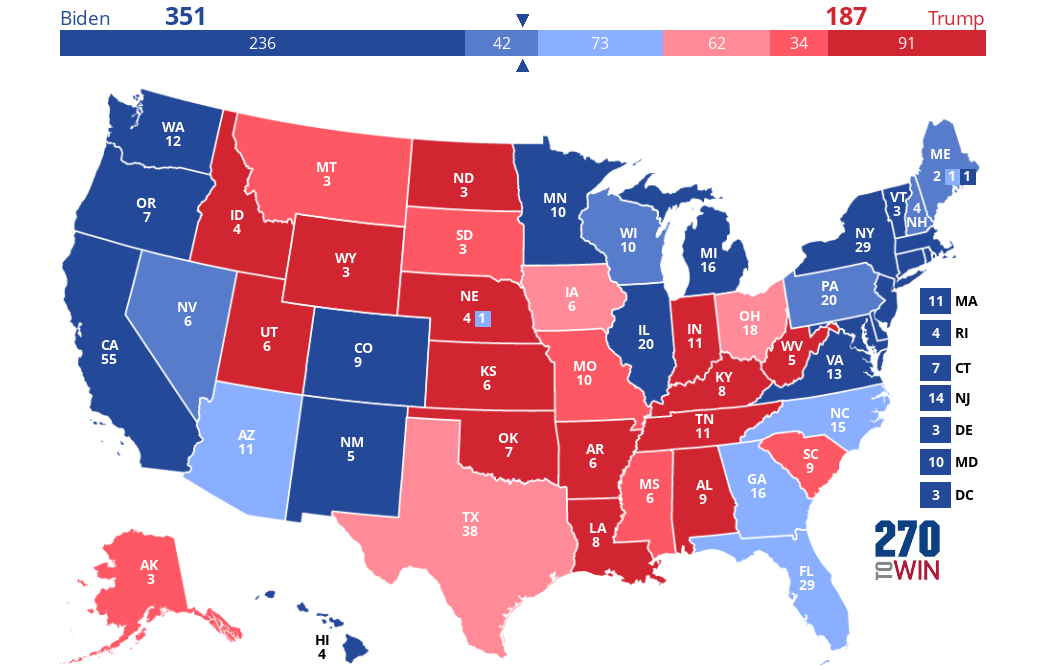
 Click the map to create your own at
You can see other scenarios at the 270 to win website including which states are considered toss-ups. The consensus forecast, which includes a number of states considered toss-ups, has Biden winning at least 290 electoral votes, enough to win the election.
On election night if Biden wins Florida, which counts early, the prospects of a Biden victory become so high that the fact that some states won't be finished their count the same night will likely not prevent the networks from making a call, particularly if another state such as Arizona or North Carolina goes for Biden. The advance and mail-in vote may be counted slowly in a number of states including the crucial three in the midwest. Several of recent elections have not been called before midnight on election day but this one may.
Wednesday, October 21, 2020
A Tale of Two Provincial Elections: Saskatchewan and BC
Saskatchewan: A Long Term Shift to the Right?
There will be provincial elections held imminently in two western provinces, British Columbia on Saturday October 24, followed by Saskatchewan on Monday October 26. Historically, the two jurisdictions have been of great importance to the New Democratic Party. Saskatchewan was home to the breakthrough election of 1944 that brought Tommy Douglas to office and would eventually produce Canada's first public health care plans.
 |
| Map of 1944 Saskatchewan Election |
The CCF (Co-operative Commonwealth Federation) and NDP have held office for 47 of the 76 years since that win in 1944, while three parties with different names but all representing the political right have held office for just 29 of those years. However, over the past several elections support for the NDP has been steadily declining while the conservative Saskatchewan party has won overwhelming majorities of the constituencies in the Saskatchwan legislature.
The polls in the current campaign so far suggest that while the NDP can expect some improvement in vote share, and could pick up some seats, the Saskatchewan Party remains headed for an a big victory. Originally the CCF represented agrarian socialism (as the map suggests) but the party soon shifted to the cities.
A new Saskatchewan Party win would mean that Saskatchewan would be headed for 17 consecutive years of small 'c' conservative governance, far exceeding the length of previous right-wing regimes. It has been a complicated multi factor process but in part it reflects the consolidation of the conservative support in almost all of rural agricultural Saskatchewan except the far north, and Saskatchewan's shift to becoming an oil province (probably a sunset industry later in this century) and conscious of its status as such - it is among the provinces vigourously challenging the federal carbon tax. Conservative parties also hold sway in rural parts of Canada elsewhere.

Results of federal elections in Saskatchewan have paralleled the provincial results, with the Conservatives under the prevous Saskatchewan-based leader Andrew Scheer winning a share of votes and seats similar to Alberta in last year's federal election.

The NDP may well turn a corner upward in this election but, given that all governments accumulate grievances, that is to be expected. However, the Saskatchewan of Dream No Little Dreams (a book I highly recommend) seems in the distant past. Indeed it seems more likely at the moment that we will see a new NDP government in Alberta before we see one in Saskatchewan.
British Columbia: Becoming a Canadian California?
About fifty years ago a book chapter on British Columbia was sub-titled The Politics of Class Conflict. BC's history is of an economy based on natural resources such as mining and fisheries that has been characterized by strong class-based conflicts between strong unions and antagonistic employers. The unions have supported political parties on the left expressing their interests.
The old CCF never won office in BC - it was not until 1972 that the NDP won office for a single term. However, the political right was sufficiently terrified of the electoral prospects of the left to have formed a coalition government of the Liberals and Conservatives in the 1940s to keep them from winning. The Social Credit governments that followed were that same coalition reconstituted along slightly different lines. The most recent expression of the same coalition can be found in the B.C. Liberal Party governments that followed the defeat of the first two term NDP government, albeit winning elections under two different leaders (Mike Harcourt in 1991 and Glen Clark in 1996). Notably, although Glen Clark lead the NDP to victory in 1996, the party actually won a smaller share of the popular vote than the BC Liberals.
While the NDP has had limited success in BC compared to Saskatchewan, the 21st century is providing brighter prospects for the party. In part the older class-based politics has given way to a politics that reflects the multiple and overlapping strains of modern political culture, marrying traditional concerns about social and economic inequality to emerging issues like climate change and the demands for recognition and respect for the range of peoples that compose our increasingly diverse society. While these social trends matter enormously, one can never underestimate the importance of leadership.
 |
| John Horgan |
The BC NDP continue to lead the opposition Liberals and the Green Party in opinion polls: based on the latest numbers I have them winning at least 52 seats in the 87 seat legislature. Beyond Saturday's result we can see that BC has a coastal politics similar to the US states of Washington, Oregon and California, a politics that trends to the left. I wrote about this in 2017 when I said:
The blue state-red state trend in the U.S. is of relatively recent vintage (until the mid-nineties Republicans were strong in California), but the trend to more left of centre views (and growing green consciousness) is clearly characteristic of the coasts in both places. Can it be too many more years before the trends evident south of the border become typical of B.C.?

In contrast, the politics of the plains province of Saskatchewan are beginng to appear similar to American states directly to its south. The last election in BC produced a close overall result between the BC Liberals and the NDP but the Greens produced a stronger showing than before. There was a dramatic increase in the combined NDP-Green vote from the prior election in 2013. The Green Party do have roots in both left wing and more conservative politics, but in BC overall they lean much more left. That jump in the combined vote from 2013 to 2017 and continuing in 2020 is something we should expect to be a theme of politics in the 21st century. As for Saskatchewan, while the analogy is far from perfect, their US neighbour North Dakota, now a highly conservative Trump voting state, was once ruled by the Non-Partisan League, a left of centre radical agrarian politcal formation that captured the state's Republican Party.
Subscribe to:
Posts (Atom)